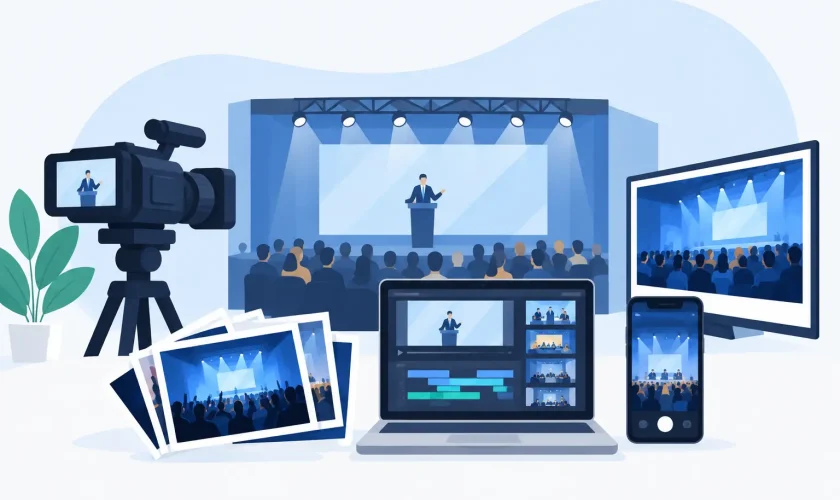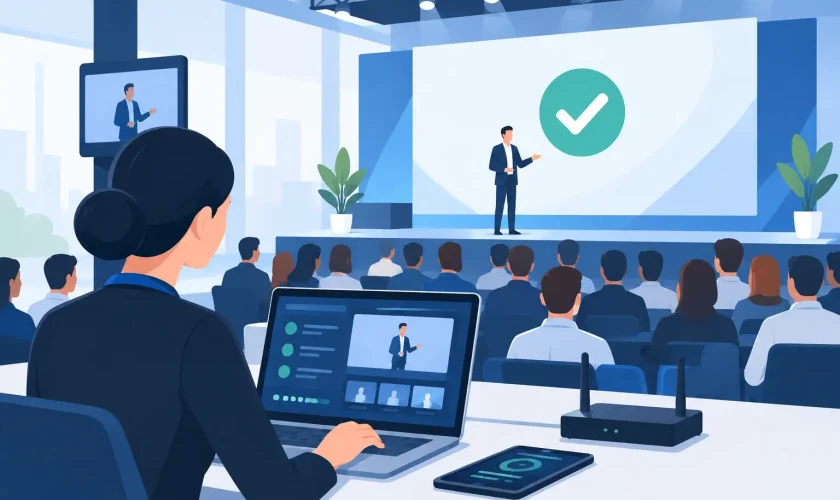

A ballroom full of people is not a story. Neither is a highlight reel of handshakes, wide shots, and a keynote speaker at a podium. A strong guide to corporate event storytelling starts with a harder question: what should someone feel, understand, or do after they see this event content?
For corporate marketers and event teams, the answer usually reaches beyond documenting the day. You may need to prove sponsor value, create social-ready assets while the event is still happening, give sales teams credible proof of momentum, and build anticipation for next year. That requires more than good cameras. It requires a clear editorial plan built around the experience your audience had in the room.
Start With the Story, Not the Shot List
A shot list is necessary. It protects the nonnegotiables: keynote speakers, sponsor activations, award recipients, executive portraits, signage, packed rooms, and key attendee interactions. But a shot list alone produces records of an event, not a story of why it mattered.
Before crews arrive, define the central narrative. A leadership summit may be about alignment and momentum. A user conference may be about a community moving an industry forward. A product launch may be about confidence, anticipation, and the first real reaction to a new offering. The story should be simple enough that every producer, photographer, videographer, and marketing stakeholder can recognize it.
Then identify the proof. If the message is innovation, show the new product in use, not only on a screen. If the event is about community, capture honest conversations, peer connections, shared reactions, and moments of recognition. If sponsors are central to the experience, show meaningful attendee engagement at their activations rather than isolated logos.
This is the difference between coverage that looks polished and content that gives marketing teams something useful to say.
Build a Story Arc Across the Event
The most effective corporate event content follows the natural rhythm of the experience. It gives viewers a sense of arrival, anticipation, participation, and resolution.
Capture the setup and sense of arrival
The story begins before the first session. Venue exteriors, directional signage, registration, branded environments, crew preparation, and early arrivals establish scale and intention. These images are especially valuable when an event transforms an ordinary convention center, hotel, or outdoor venue into a branded experience.
Do not overproduce this stage. It should feel intentional, not empty. A pristine room is useful, but a room becomes more compelling when people enter it, notice the details, and begin to engage.
Show the energy in the room
Keynotes and general sessions are often the visual center of a corporate event, but the audience is what gives them weight. Capture speaker moments alongside crowd reactions, applause, note-taking, conversations during transitions, and the visual scale of a full room.
For video, the editorial rhythm matters. A film that stays on speakers for too long can feel like a recording. A film that only cuts quickly between applause and décor can feel generic. The strongest approach combines both: the message on stage, the human response, and the branded environment that connects them.
Find the moments between the agenda items
Some of the best storytelling happens outside the main program. A mentor greeting a colleague. A customer asking a thoughtful question at a demo. A team celebrating after an award. A sponsor representative in a substantive conversation instead of posing for a photo.
These moments cannot be scheduled with precision, which is why experienced event crews matter. They know when to stay near the stage, when to move to the hallway, and when a networking reception is producing stronger material than the planned photo opportunity.
Give the ending a purpose
Every event has a final note, even if there is no formal closing session. It may be a final keynote takeaway, a celebratory reception, a shared commitment, or attendees leaving with visible energy. Capture what completion looks like.
That closing material helps turn a collection of sessions into a complete narrative. It also gives future-event promotions a useful message: this is where the experience leads.
Plan Content for More Than One Audience
Corporate event storytelling has to work across several channels and stakeholders. One event may need an executive recap, a sponsor gallery, social clips, sales materials, recruitment content, and next year’s registration campaign. Trying to create one piece for all of them usually results in a vague asset that serves none of them well.
Instead, decide which stories need to be told from the beginning. Your executive team may need proof of strategic alignment and attendance. Sponsors may need clear visibility, foot traffic, product engagement, and brand integration. Attendees may respond to people, practical takeaways, and a feeling of belonging. Prospective attendees want to see the value and energy they missed.
This does not mean building separate productions for every audience. It means capturing coverage with intentional variations: vertical clips for social, wide shots for scale, clean sponsor imagery, interview moments, detailed environmental images, and enough human interaction to make the event feel alive.
The trade-off is focus. The more deliverables you request late in the process, the more likely important footage or photography will be missing. Prioritize the audiences and outcomes that matter most before the event begins.
Make Brand Guidelines Visible in the Coverage Plan
Off-brand event content creates problems even when the images are technically strong. A premium brand may need refined compositions, intentional lighting, and a measured edit. A bold product brand may need more movement, color, interaction, and pace. Both approaches can work, but they should not look the same.
Share brand guidelines, campaign messaging, examples of approved content, speaker priorities, and sponsor commitments with the production team in advance. Flag visual sensitivities, including which logos need clear representation, which product views are restricted, and whether certain attendees require approval.
The creative direction should also define what to avoid. For example, a crowded expo hall can communicate demand, but poorly framed congestion can make the experience look disorganized. A lively reception can communicate connection, but images should still match the professionalism expected of the brand.
Clear guidance gives the crew room to make smart decisions quickly without asking the marketing team to approve every frame on site.
Treat Fast Delivery as Part of the Story
An event has its strongest marketing window while it is still happening. If photography arrives a week later, social teams have lost the chance to publish timely recaps, recognize speakers, spotlight sponsors, and extend the conversation in real time.
Build a delivery schedule that matches the event calendar. Same-day priority selects can support live social posting, media outreach, and executive communications. Next-day photography keeps recap emails and post-event posts moving. A short recap film may follow after the event, while a larger organized library supports campaigns for months.
Speed should not mean sending an unfiltered folder of near-duplicates. Fast delivery is most valuable when the content is selected, organized, color-consistent, and easy for internal teams to find. Clear file naming, galleries by day or program area, and dedicated sponsor folders reduce the work that falls back on your marketing team.
Use Interviews Carefully
Interviews can add meaning that visuals alone cannot provide, especially for summits, leadership meetings, customer conferences, and product launches. A customer explaining why a new solution matters can be more credible than a graphic repeating the same message.
But interviews need a purpose. Avoid asking every participant for a broad reaction to the event. Prepare a short set of questions tied to the narrative: What challenge brought you here? What idea changed your perspective? What did you see that makes you optimistic? Keep answers concise and conversational.
Not every event needs interviews. For an immersive brand activation, visual energy and authentic attendee reactions may be more effective. For a multi-day conference built around thought leadership, interviews can provide the connective tissue that turns event footage into a more complete film.
Measure Whether the Story Worked
A cinematic recap is valuable, but performance should be judged against the objective set before the event. For sponsor content, that may include usable brand visibility, activation images, or social engagement. For future-event promotion, it may be video completion rates, landing-page engagement, registration activity, or sales-team use. For internal meetings, the measure may be leadership adoption and employee participation.
Also review the practical result. Did the team receive the right content when it was needed? Were important speakers, sponsors, and moments covered? Was the library organized enough to use without a long search? These operational details determine whether event content becomes a lasting asset or disappears into a folder.
AXIA Event Media approaches corporate coverage as one coordinated visual operation, bringing photography and video together under a plan that protects key moments and supports faster delivery. For complex events, that level of coordination is often what keeps the story intact.
The best event story is not the loudest one. It is the one that makes someone who was not in the room understand why they should want to be there next time.